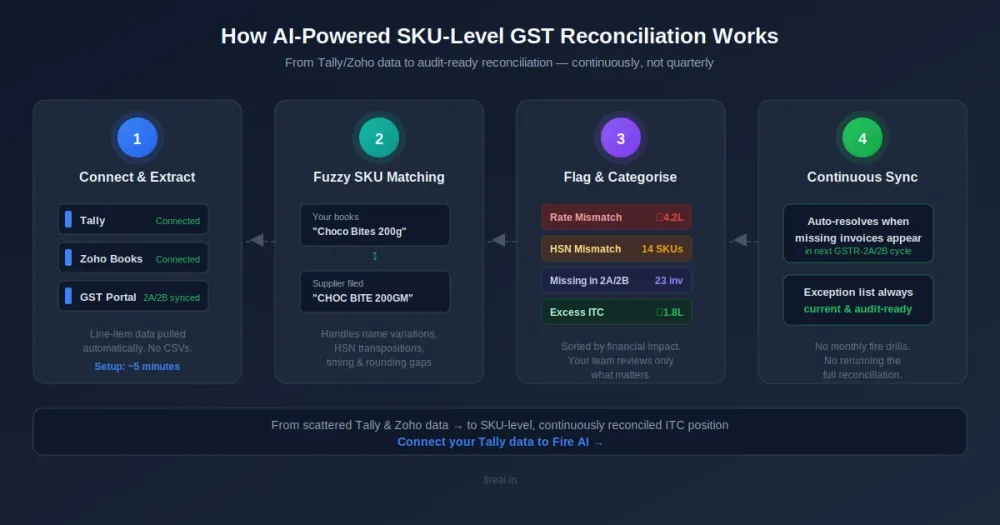
Reconciliation analytics is the use of data, rules, and workflows to make matching between two or more record sets fast, auditable, and exception-driven instead of hidden in month-end spreadsheet marathons. It applies to bank statements, purchase bills, tax filings, carrier invoices, and any place where "our number" must equal "their number" with a defensible trail.
For Indian companies, recon work often sits in Tally, email PDFs, and GSTR tools at the same time. This page defines major reconciliation types, how manual and automated approaches differ, and how FireAI ties reconciliation to live analytics from Tally and connected systems. For sector context, see FMCG finance use cases and logistics finance use cases.
Major types of reconciliation analytics
Bank reconciliation
Bank reconciliation matches your cash book in Tally (or ERP) to bank statement lines, including timing differences, bank charges, and stale instruments. Analytics adds unreconciled ageing, multi-account cash views, and trending exception counts so finance sees drift before the month closes. A focused Tally view lives in Tally bank reconciliation.
Vendor and three-way matching
Vendor reconciliation pairs purchase orders, goods receipt or service proof, and supplier invoices (three-way match) to prevent duplicate payables and price drift. Analytics surfaces mismatch reason codes, vendor-level dispute rates, and days-to-close for open items, which category managers and finance can review together.
GST reconciliation (GSTR-1, GSTR-3B, GSTR-2B)
GST analytics focuses on matching sales and purchases in books to what was filed and what appears in portal data, to catch missed credits, late uploads, and invoice-level gaps. A procedural deep dive is in how to automate GST reconciliation from Tally, and the "can AI help?" angle is in can AI automate GST reconciliation.
Freight and logistics invoice reconciliation
Freight reconciliation matches carrier or 3PL bills to agreed rates, weight or volume, trips, and fuel or accessorial lines. Mismatches often appear at lane, shipment ID, or tax slab level. Analytics helps logistics finance teams prioritise which carriers or routes drive the most leakage before negotiation season.
| Type | What you are matching | Typical pain without analytics |
|---|---|---|
| Bank | Ledger vs bank statement | Stale BRS, unknown unreconciled balance |
| Vendor | PO / GRN / invoice | Duplicate payments, price variance |
| GST | Books vs GSTR / 2B | ITC loss, notice risk, late discovery |
| Freight | Trips + rates vs bill | Cumulative overbilling, slow 3-way match |
Manual reconciliation vs analytics-driven workflows
Manual reconciliation usually means exports, vlookups, and email follow-ups. It works for low volume, but it scales poorly: errors hide in "small" differences, and root cause is rarely visible until audit or a tax review.
Analytics-driven reconciliation means:
- Exception-first queues: the system flags what does not match, in priority order
- Standard rules and tolerances for amount, date, and reference key matching
- KPIs such as first-pass match rate, average days to clear exceptions, and value still open
- Audit history of who changed a match and why
Reconciliation analytics is not "BI on top of Excel." It is the layer that operationalises matching so the same data can feed financial dashboards and revenue analytics with fewer restatements.
How FireAI auto-reconciles from Tally data
Data sync: FireAI connects to Tally Prime ledgers, vouchers, and masters on a schedule that keeps books aligned with your analytics layer (see analyse Tally data with AI).
Matching engine: Configurable rules map bank lines to receipts and payments, vendor lines to purchase cycles, and tax fields to the structures your CA expects for GSTR work. Tolerances and split-line logic reduce noise while still surfacing material gaps.
Dashboards and NLQ: Teams monitor unreconciled value, ageing buckets, and exception trends in one place. You can ask plain-language questions about open items or last month's match rate without rebuilding pivot tables.
Cross-system paths: For logistics and multi-entity groups, FireAI can combine Tally with trip or billing feeds so freight and intercompany style breaks show up in the same exception discipline, consistent with the finance stories on logistics finance use cases.
Where reconciliation analytics creates the most value
- FMCG and distribution: high invoice volume, DMS and scheme credits that must tie to Tally. Start from FMCG finance use cases.
- Logistics and 3PL: freight, fuel, and accessorial lines that do not line up to dispatch data without systematic matching. See logistics finance use cases.
- Any Tally-first SME scaling past manual BRS: the earlier analytics-driven recon is adopted, the less costly it is to fix master data and process gaps later.