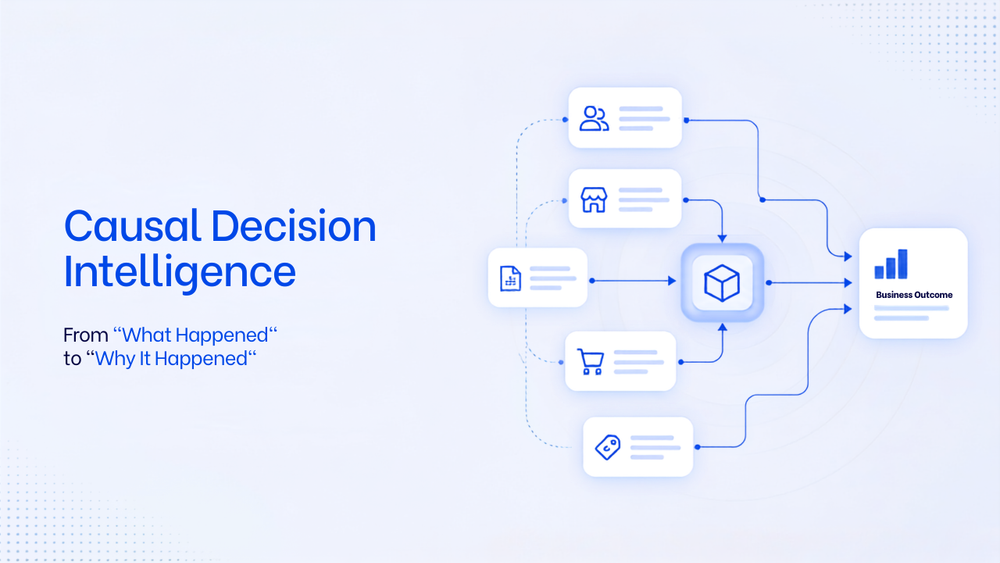
How does causal decision intelligence help your business?
Sales are down. Your team has three explanations: fewer enquiries, higher prices, or products being unavailable when customers need them.
Each explanation calls for a different response. Before spending more on advertising or offering a discount, you need to understand which explanation the evidence supports.
Causal decision intelligence brings that investigation into the decision process. It connects a business question with possible causes, actions you can take, and results you can measure.
Tools such as FireAI's Causal Chain support this work by helping teams explore relationships and candidate root causes across connected business data.
A practical example: orders rise, but revenue falls
Consider a Pune distributor using Tally alongside order and stock records. If monthly revenue falls from ₹40 lakh to ₹32 lakh despite rising orders, the business faces an ₹8 lakh monthly shortfall, or a 20% decline.
Before offering a discount, the sales manager can compare invoices, cancelled orders, stock availability, and supplier delivery dates to understand the gap.
To work through the decision, use the following breakdown of the ₹8 lakh shortfall:
- ₹5 lakh in cancelled orders following stockouts of popular products.
- ₹2 lakh in orders delayed into the next month after late purchase receipts.
- ₹1 lakh in other reductions, including lower demand for slower-moving products.
This breakdown directs attention to ₹7 lakh in cancelled or delayed orders. The team should check whether shortages preceded cancellations, compare affected products with products that stayed in stock, and account for seasonality and pricing changes. Delayed orders may shift revenue between months; they are not automatically lost sales.
If a stock-replenishment trial prevents 40% of the ₹5 lakh in cancellations, it would retain ₹2 lakh in monthly revenue. At a 20% gross margin, that is ₹40,000 in gross profit before extra costs. With ₹15,000 per month in additional stockholding and fulfilment costs, the estimated incremental contribution would be ₹25,000 per month.
The team can test an earlier reorder point and track fulfilled orders, cancellation value, inventory costs, and contribution. These calculations help compare actions; the measured trial results determine whether the change should expand.
How does causal decision intelligence work?
The process usually involves four steps:
- Define the decision. Be specific: "Should we increase stock for these products?" is more useful than "Why are sales weak?"
- Investigate possible causes. Check timing, business conditions, and competing explanations. Use diagnostic analytics to locate where the change occurred.
- Compare actions. Estimate what could happen under different choices, including the costs and assumptions behind each.
- Test and review. Where practical, trial the change and measure its effect before expanding it.
How does it fit within the four types of analytics?
Predictive analytics estimates what is likely to happen from patterns in data. Causal decision intelligence considers how an action might change that outcome.
| Approach | Example question |
|---|---|
| Descriptive | What happened to sales this month? |
| Diagnostic | Why did sales decline, and what evidence supports the explanation? |
| Predictive | What sales should we expect next month? |
| Prescriptive | What should we do to improve sales within our stock and cost limits? |
Causal decision intelligence supports prescriptive analytics by estimating how an intervention could change an outcome and comparing actions against business goals, costs, and constraints. Descriptive, diagnostic, and predictive analytics provide inputs to that decision. Together, these approaches connect business reporting with informed action.
Which techniques are used in causal decision intelligence?
- Causal mapping: Map proposed links between business drivers and outcomes, such as supplier delays, stockouts, cancellations, and revenue. Treat each link as a claim to investigate.
- Controlled experiments: Compare an intervention with a suitable control group, using random assignment where practical, to estimate the effect of a change.
- Observational causal analysis: When experiments are impractical, methods such as matching or difference-in-differences can support causal estimates if their assumptions hold. Relevant confounders and pre-existing trends must be examined.
- Counterfactual and sensitivity analysis: Compare what could happen under different actions, then vary assumptions about demand, costs, and effect size to see whether the preferred decision changes.
Why is correlation alone not enough?
Two figures moving together does not establish cause.
Stores with longer opening hours may record higher sales. But those stores might also be larger or located in busier areas. Extending the hours at every store may not deliver the same result.
Causal analysis examines alternative explanations and the assumptions needed to estimate an action's effect. Reliable conclusions depend on suitable data and methods; connecting data alone does not prove causation.
How does FireAI support this process?
FireAI connects business sources such as Tally, CRM systems, Shopify, and spreadsheets. Its Causal Chain feature helps users investigate relationships between business drivers and outcomes through natural-language questions.
Teams can explore possible explanations for a KPI change and review candidate root causes. Those findings provide a starting point for deciding what to investigate or test next.
For more background, read FireAI's guide to causal decision intelligence.